Saturday, August 6, 2011

Rough in the Jungle

Tea Plantation in the Cameron Highlands

Malaysia is an interesting confluence of cultural factors, with a variety of languages, food, landscapes, and religion. Actually it's largely Muslim, which might surprise some of you out there. Indeed, as we walked through the beautiful explosion of brilliant colors at the Penang Island Butterfly Garden we passed numerous couples, buff Malay guys in jeans and polo shirts with [fake?] brand name logos with their wives in full black burkas, showing naught but dark eyes. (Also notable experiences at the Butterfly Garden are holding giant centipedes and----brace yourself----scorpions. Our guide said they were a harmless "level 5." I asked afterward, "So how bad is a level 5 scorpion sting?" and he said, "Oh not so bad, only fever and chills for a couple of days. Like a bee sting." Woah!)


As you can see from the attached map of Asia, we've come quite a long way (actually Thailand, Laos, Vietnam, Cambodia, Myanmar, and Malaysia don't look too far away on the map but we've got the psychic wounds of poor sleep on long buses to prove the distance). This map also reveals the location of Malaysia as directly between India and China on the sea-trade route. As such, Malaysia has been of strategic importance to global trade since the 1st Century CE and bears the diversity to prove it.

Early on Hinduism and Buddhism reigned supreme but Arabic and Islamic Indian traders brought a new religion in the 10th Century that came to dominate politics and economy by the 14th Century. The Portuguese decided in the 16th Century to wrestle control of the spice trade from the Italians, who got their spices from the Arabs, who got them from the Indians, who got them from Malaysia! So they took over a port in southern Malaysia and were followed shortly by the Dutch. The English came with an eye for trade but eventually took over the whole of Malaysia by 1824, leaving profound influence. Notably, nearly everyone here speaks English. It's been really great getting to understand people when we ask for directions or ask about some symbols (like the swastika: "may you prosper and have good fortune").

Also, the British facilitated enormous immigration from India and China, to the point that native Malays became the minority at one point. During WWII Malaysia was commandeered by the ruthless Japanese and it became clear that the British could no longer hold them and they became an independent nation in 1963. Since then they've experienced rapid growth, which brings us here to this towering city: Kuala Lumpur, home of the tallest buildings in Asia, the twin Petronas Towers.

But mostly we've spent time in the jungle.

After a few days in the cool of the mountains (imagine being closer to the equator than I've ever been and shivering in my sweater at night!) of the Cameron Highlands, eating sweet mountain-grown strawberries, we headed into the wild: Taman Negara (Malay for "National Park"). After three hot hours in the sun chugging along up the river, we arrived at a string of floating restaurants, where we later found we would eat dinner every night, each time with another (usually French) couple because there were no free tables. That night we had our first encounter with unexpected jungle insects: NIGHT BEES! AHHH! They only come out at night and they love the light so they swarmed our little bamboo bungalow (and our amiable host assured us they sting and they hurt).


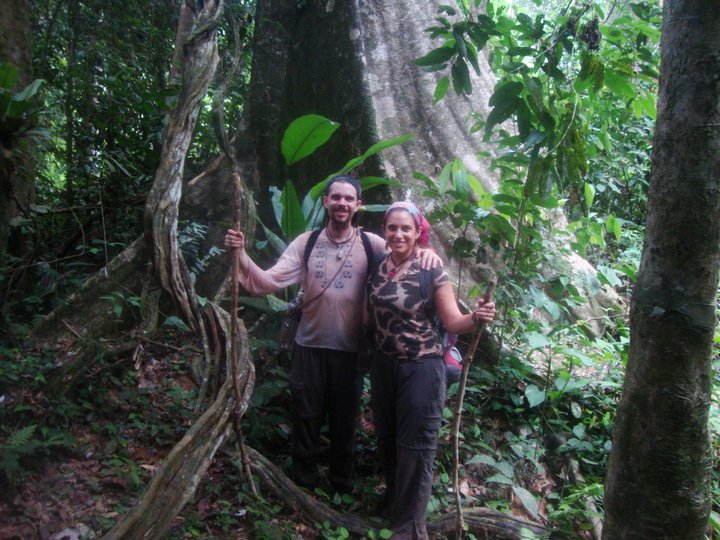
Our first full day we headed into "The World's Oldest Rainforest" (as Sarah's souvenir t-shirt proclaims, along with a picture of a tapir)----130 million years old, untouched by glaciers and volcanoes----and made a *bee-line* for "The World's Longest Canopy Walk," over 500 meters of walkway suspended on cables from 30-50 meters above the thick jungle foliage below. It was so scary! The thick jungle extended above us as well, mind you. Some of the trees there are unbelievably enormous. We saw huge vines as thick as my torso winding up and down these monoliths and often had to climb over gnarly tree roots as if they were huge fallen trees.

Then comes the big jungle adventure: wending our way through beside the river for 11km of quite hilly trails. Hilly isn't exactly the right word. We often had to grip lattices of tree roots to climb up the insurmountable slopes. We also had to trudge our way through streams so clear and clean (untouched by the filth of human civilization) that we were able to fill our water bottles from them and stay hydrated all day long. Oh right, and we saw an enormous MONITOR LIZARD! It was a good three feet long and barely moved its eyes as we passed it on the trail, very unsettling. Once while scaling one of the endless ascents Sarah nearly knocked me back into a stream when a swarm of bats exploded off a tree branch beside the path! There weren't many people around.


Seven thigh burning hours later we got to the hide, which was a big cabin high on stilts overlooking a watering hole, about ready to collapse but the small assembly turned to us and adamantly said, "SHHHHH...." (some welcoming party) and pointed out the window to............a TAPIR! Magical. It's like a mixture between a little hippopotamus and a panda bear, split black and white down the middle of their back, but with a big floppy nose that bounces around as they walk. It made the whole walk worth it.

All the same, Sarah insisted that we take the "easier" trail through the heart of the jungle, which was admittedly much flatter. But I found it much more challenging, at least mentally, due to the enormous population of LEECHES squirming on the path, reaching like skinny little demon fingers from the muddy depths of the jungle inferno for our blood! Well, I managed to get out without a bite, although one did manage to make it to my wrist, which he probably aimed to gorge on and then slit up the vein to leave me writhing in the tangle of vines and spiders (truly villains, leeches). Sarah, however, was not so lucky. She got hit in the ankle with two brown squirming bullets and is now in critical condition in K.L.Advent International Hospital. Just kidding (bad one, I know), leeches are actually harmless, transmitting no diseases and incapable of draining sufficient blood to floor you, but they still freak me out...vile creatures.


Well now we're couch surfing with a wonderful family in Kuala Lumpur, the big city. We get to play silly games that involve lots of animals and explosions with Rica, our host's, 7 and 10 year old kids. Tonight we're meeting up with our friends who we met trekking in Myanmar who live here, Iga and Matteos! In two days we shall be flying to Borneo to get off even the not-so-beaten paths of Taman Negara and into the really deep untouched jungle.


Additions to Happy Trails

On June 23, at 10:50 PM (Thailand Time) we acquired 2 temporary additions to our adventure! Travis's mother and sister flew all the way from the USA just to meet us for 2 weeks of crazy Thailand adventures! It worked out perfectly as we had just flown in from Yangon, Myanmar 2 hours before. After our happy reunion we taxied it to Teresa's (alas not present) swanky apartment and stayed up late talking, all of us excited despite our long day's travels.

The next day we all went to the Grand Palace. It is the King's house, and looks rightly so. Every surface encrusted with colorful tilework or shimmering with mirrors, I just enjoyed myself so much with Katy and Mom's exclamations of "Oh Wow!" and "This is the most beautiful place I've ever been!". It really let me see this marvel in an even more fresh and delightful light, through two fresh arrivals and their wonder rubbing off on me. It made me remember how much everything pops when you first get to a place. The mundane is so interesting and delightful, like the spirit houses: tiny houses that stores, hotels, offices, and family homes put in their main areas as little altars covered in fruit, flowers and little statues. They are each unique and have their own flair, but I have seen so many of them I hardly notice them now. Katy and Mom were so amused by them that it made me think about how awesome they were again.

One day since they have arrived sticks out in my mind as one of the best that I have had since we have been on this trip. We began in a songteaw (a pickup truck with seats and a cover installed in the bed) that we hired for the day, in the rain. That's right folks, it's the rainy season. It rains almost every day, and the foliage is so lush for it. By the time we got to Erawan State Park the rain had abated, and the humidity started to climb. We walked down the red dirt path, skipping over rocks and vines with the drops forming little jewels all over the leaves beside. Soon we arrived at the attraction: some of the most beautiful waterfalls I have ever seen. Since it had rained that day, I guess most people had decided to skip the waterfalls that day, so we had the place to ourselves. We dove into the water and swam underneath the pounding falls. We had like a little room underneath, where could sit underneath and look out at the jungle. The little fishes nibbled our legs when we we swam back. There were actually 7 of these waterfalls but sadly we only made it to 3, as we had another appointment.

Our next destination was one that I had been looking forward to since I began planning this trip, and I am so so happy that Mom and Katy (and of course my beloved husband) could be there to share it: The Tiger Temple! We paid 600 Baht (USD$20) to get in and oh how the fun began. On our way in was an open forest type area with wild pigs and deer roaming freely. We spotted up ahead the animal of our goal: the tigers! A few older tiger cubs lolled about with monks on the other end of their leashes, and we approached excitedly. The beautiful orange and black coat, the alert, inquisitive eyes, oh what power and awe it was to touch this rare and sacred animal. Never in my life will I forget the surge I got that first physical connection I made with this feline.

Only a few moments later we were standing in line to have our photos taken with the big tigers. A small Thai woman led us around by the hand individually to get a chance to touch 6 or 8 more adult tigers. These huge, beautiful beasts slumbered away as oodles of tourists timidly stroked their paws and grinned nervously for photos...such an unforgettable experience when it was my turn. Katy, Mom and Travis were all equally amazed as me at their incredible luck at getting to visit this special place. I was there and I can assure you, these tigers were not drugged. Only a few minutes after laying placidly like huge kittens they were batting at their toys and rolling over one another during "exercise time". This was a very professional establishment and there were many trainers and safety precautions implemented. Ok, there is a tiny, tiny chance of getting mauled, as tigers are wild animals, but 500 tourists do this every day and there have been no problems that I've heard of (and I've done research on this place) so I figured the potential benefits would be greater than the risks. And how right I was.

Now we are relaxing at a beautiful resort on Koh Lanta, in South Thailand, on the Andaman Coast. This place is swank. A pool with an infinity edge overlooking the white sand, palm fringed beach, a cute dog to greet us every day, and the best pad thai on this side of the Indian Ocean, is making doing nothing at the beach a something sort of experience. Yesterday Katy and Mom rented motorbikes and Katy had her first try at driving the bike, and she did great, even down a steep and rocky hill. Tomorrow we are going kyaking at some nearby uninhabited islands. We are so happy that they are here, and they have made the last two weeks like a vacation from our vacation. Haha you need those sometimes, and the beach is just the place for it.


Family Fun Photos!
Tiger Photos! Oh my!


---
Originally written on 3rd July 2011

Monday, June 27, 2011

Bagan's Myriad Magical Monuments

Slowly rising up the cracked brick stairs, still solid after a thousands years, in the darkened temple; stooping under the low brick archways; stepping out into the beaming Burmese sunlight, we exalted at the unimaginable bounty of beauty springing forth before us. Oh glorious majesty, thy name is Bagan! The myriad magical monuments that blossomed under the endless swirling clouds inspired such awe as to strike the heart with furious devotion to the enthralling aesthetics of the human mind and will. Gazing in unabashed wonder at the unimaginable tableau of temples that grew up before us, brick by brick, rising towards the searing brilliance of the sun, spreading out across the vast plains to the mountains beyond. Thousands of sharp-pointed temples, immaculate despite their ancient conception, bombard our contemplative complexes and surge a shiver of awe quaking through our bodies.

Alas, lo these mere lofty incantations prove utterly insufficient to disclose the lustrous celestial wonder imbued in this magnificent ancient city. Let's shift: THOUSANDS of temples, people. Thousands. Over 4,000 temples were built over the last thousand years, largely in the 11th and 13th Centuries, under two particularly fervent kings. Time, wear, and a harsh earthquake in 1975 has left some 2,500 temples standing in this city only 16 square miles in size, smaller than Manhattan. Everywhere you look there are more temples. We would bike down the road and pass hundreds of temples that we'd definitely go to if there weren't even bigger and better temples to come!

Our first day in Bagan we ran into a couple of German girls, Carina and Magdalina, we had met a few times in Mandalay. It's amazing how few tourists are in Myanmar. You run into the same tourists repeatedly. In fact, we shared a flight back to Bangkok with Carina. We hired a taxi (the back of a deli-mustard-yellow Toyota pickup truck from the '80s) with another couple of women and headed for the strange site of Mount Popa! On the way we stopped in a village to use the toilet (an outhouse with a squat toilet that has a tube that disappears mysteriously into the ground below) and the family showed us how they use palm for everything: fruit, juice, wine, whiskey, sugar, tables, chairs, little baskets, their entire house! Near the thatched-palm-leaf roof supported on palm branches a huge ox walked in endless circles crushing peanuts for their oil in a giant mortar and pestle.

Mount Popa was a strange sight to see: a huge temple perched high atop a really steep flat-topped hill---very bizarre! A flat-topped, steep-sloped hill is called a butte, as I just found out on a landforms vocabulary site, and this one was particularly steep. As we climbed the 777 stairs of the hill we skirted monkey droppings on the stairs, tipping the guys with mops.

Then, surprise, MONKEYS! Sarah was thinking about buying "monkey food" packets when a monkey jumped right up on her head! As I was snapping a shot of that stunned stunning beauty another monkey jumped right up on MY head (not photographed). The view from the top was lacking due to indelible cloud cover but the whole path was lined with shrines to Nats, traditional animistic spirits, 37 all told.

On the way back pulled up a rutted gravel road to a "petrified forest" and marvelled at the cement tree stumps that we at first thought were immaculately preserved trees. Turns out that, as many things in Myanmar, the "forest" was greatly exaggerated, as only a few fragments of pretty cool chunks of rock greeted us, the lines of the grain frozen in time.

Most of our week in Bagan we spent riding bikes on bumpy roads up and down little hills ("Mountains!" Sarah insisted) but one day we hired a horsecart. Now I've always thought that horses were evil incarnate, giant mutant hell-beasts bent on crushing the skulls of the innocent but Sarah loves them so we hopped up in a covered (and comfortably cushioned) cart). Our horse's name was Santa and she seemed very nice at first, as we rode across the wretched sandy paths through the thorny scrub. Cullon, our driver, led us through endless clusters of little temples, which we occasionally demanded to explore, eventually leading us past a government-owned expensive-hotel-tower to a big temple, which we climbed. Even in the pouring rain the view is incredible. I was constantly blown away by the sheer number of these huge temples in this city!

Each individual temple is pretty amazing, too. The nextdoor temple had original Buddhist murals from the 11th Century. It's interesting how diverse the murals in different temples are, changing in colors, styles, and even religious content. Cultivated deep in the complex soils of the verdant Myanmar collective culture, Buddhas, Hindu gods, and animistic spirits intertwine in complex symbiotic relationships to dazzle the mind and eye. There's also a painted story about two bird-people lovers who are separated for one night and cry every day for the next seven years---"Romeo and Juliette," the temple caretakers all say.

At many of the temples we had to fend off vendors, who are ravenous for business in the rainy season, with fewer tourists about. We did end up buying a ridiculous number of fetching paintings from skilled local artists, many of which were copies from the art on the temple walls. We got a seven-headed elephant, some happy fish, scenes from the 11th Century monarchy, temples at sunset, and more (though some are for my Uncle David and Aunt Kim, who commissioned us to buy art and handicrafts to support Myanmar artisans). At a couple of temples vendors would actually hop on bikes and follow us to the next temple to try to sell their Buddha-head statues or laquerware coasters.

We ate lunch under the corrugated aluminum roof of a little village restaurant, pinging loudly in the rain. We were talking to another tourist, the first we had seen all day, and it turns out he teaches in Bangkok and is friends with Teresa (who we stayed with in the big city) and heard through the grapevine that we had arrived. Small world! We hung out with him the next day when both he and Sarah got flat tires and I magically lost them for 2 hours after taking an inescapably blurry photo of a temple at twilight (only after I had given Sarah the only proper working bike---chivalry is not dead!).

After lunch we walked around the village and saw their colorful looms and bamboo handicrafts. We didn't bring enough money to Myanmar though and you can't get any more because there are no banks US and EU have embargoes against Myanmar due to the atrocities of the despotic military regime so we had declared it a "souvenir free day" but the people were kind and welcoming anyway, showing us around their bamboo-walled homes.

When it rains it pours in the rainy season and we could always seek sanctuary in the temples but poor Santa, our pony, was left out in the torrent. The roads turned into rivers and ankle-deep puddles and Santa was so unhappy she started kicking the cart! Each time she kicked it would ring out in a thunderous boom and chunks of wood went flying! It was a little scary and we decided to walk after we saw the stream of blood running down her leg, cut from kicking.

On our last day our whole Bagan experience seemed to come together. We ate our daily delicious local breakfast in the kitchen of our guesthouse, the leftovers from the extremely kind family we stayed with. We then hopped on bikes and proceeded to see nearly every local we've met in Bagan. A guy named Mumbay loved my little 4-faced Avalokiteshvara statue so much I gave it to him (he gave us pineapple smoothies and taught us weird traditional massage techniques atop a temple) and showed us how he had a silversmith turn it into a necklace. I played guitar for a kid name Lelean who sold us George Orwell's Burmese Days a few days prior, with much applause from his friends. Pupiew, who sold us the 7-headed elephant painting, later seranaded us with Burmese ballads and his animated wife smeared tanaka on Sarah's cheeks---bark paste the women use as beauty cream and sunscreen. A curly-haired Buddhist named Quality who showed us his clicker meditation counter (instead of the old-fashioned rosery beads) sold Sarah new pink sunglasses and showed us around a huge white-walled temple.


An extremely kind and charismatic fellow we met (who shall remain unnamed) even invited us to his house for lunch! We were running late but happened to run into him on the road there and he took us the entire confusing route (our plan was to ask around, the old fashioned way). His wife made us an incredible lunch: rice with tofu, watercress, potato curry, broad beans, and other Myanmar delights. We all sat around a low table on the elevated platform of their house where they eat by day and sleep by night and talked about the culture of Myanmar, among other things. Our kind host delved deep into the injustices of the government, stealing land without compensation, robbing businesses, and killing or imprisoning even minor dissidents. He teaches English at a monastery school in a village an hour away and we gave him enough money to buy 50 new books for the students (yes, he's legit). He is writing a book about the political situation in Myanmar and asked if we could have someone who was coming to Myanmar bring an audio recorder for him. Now I happened to HAVE an audio recorder on me, which I use for recording songs, and he was so happy when I gave it to him that he gave me the stone around his neck that he got from a monk who said it would bring him luck and protection. It was an incredible encounter with him and his whole family.

We saw half a dozen rainbows arching over the endless fields of towering magestic temples in the week we were in Bagan. We'll never forget it.


More pictures from this magical ancient city: http://www.facebook.com/media/set/?set=a.936452534635.2408981.18403674&l=c1df66ad12

Mandalay Days (mini-edition!)

Scene from a modern Hindu temple in downtown Mandalay.


Widely considered to be the "world's biggest book," with 729 huge marble slabs in which the entire 15 volume religious text, teh Tripitaka, is carved in the ancient language of Pali.

This formidable fellow is the most sacred Buddha image in all of Myanmar. Every day men congregate to layer more and more gold foil on his body---so much his fingers are disappearing!---while the women are forced to meditate at a distance.

A teak-wood bridge that stretches to the horizon---longest in the world---where monks congregate in the evening to watch the moon rise.


Oh he's a hungry one.

Hiking Kalaw to Inle Lake


Hello once again from Myanmar. The past 3 days we have been on a trek through some amazing scenery. We began our adventure in Kalaw, a nighttime bus ride away from Yangon. We set off energetically in the morning: Travis and Sarah, whom you know well, Ega (Polish) and Mattio (Brazil), Connor (Irish) and Zoe (British), and our guide Jimmy, a Burmese man. We talk and walk jauntily through the rolling hills. The scenery soon becomes bucolic. It is nice and cool for once and only rains a little. We pass men and women caring for their vegetable patches that cover the landscape like a green quilt. In the distance we can see patches of virgin rainforest on the mountains. Sometimes we would walk by small gold zedis or we would see them in the distance.
We visited hilltribe villages and a school. When the children playing outside the school saw us they ran up and proceeded to shake our hands one by one. They laughed hysterically when we would take photos of them and then show them. Surprisingly, the most aggressive and bullyish children were the novice monks.
As we walked through the village people would invite us in for tea so sometimes we would get to take a rest. The first night we spent in a village. The accomodation was very basic, a bunch of beds in a row on the floor. No electricity in the whole village! Can you believe it? The food cooked by the family was so good, so many kinds of Burmese curries, like cauliflower, potato, and peanut. After dinner we all talked and joked around over a fine 2$ bottle of whisky.


Bright and early the morning we began again. We walked through even more beautiful scenery, and sometimes saw buffaloes grazing or helping farmers plow the fields. We asked Jimmy if the people used chemicals on the farms. He said "No, only traditional herbs." Only a minute later however, we walked by a man spraying the plants with something that smelled very suspiciously like chemical pesticides. Oh well.

We stopped at a train station for a rest. Soon a train pulled up and a flurry of action began. People carrying huge bundles of veggies and fruits sold them to passengers on the train through the windows. Monks, children, dogs, and hilltribe people in colorful headscarves were all in on the action. The sky sprinkled refreshingly on us as we walked to our sleeping spot for the night.

We stayed that night in a monastery. The beds were a bit softer here, and there was electricity from 6-9 pm thanks to a generator, but the outhouse was up a steep hill. At night this brought out my often dormant fear of tigers. For dinner we had some amazing vegetable curries prepared by "Cooking Man".

The next day we hiked down a steep rocky trail through some lush rainforest, past jade rice paddies and ended up at Inle Lake. There we boarded a boat that took us to the Jumping Cat Monastery. A sign that said: "Please if you want to see cat jumping donation for cat food" prompted us to drop 200 kyat each into the box. A woman came out shaking a box of cat treats and soon she had 6 or 7 cats congregated around. She took a little hoop out and proceeded to make each one jump through it. It was so amazing!


More photos of trekking through beautiful mountains to Inle Lake:
http://www.facebook.com/media/set/?set=a.928031819815.2406144.18419229&l=d7ccab3076


---
Originally written June 13, 2011.

Giant Buddhas and a Magical Golden Rock

We've continuing our odyssey in the mystical land of Myanmar (aka Burma), where gleaming golden stupas rise up out of the idyllic fields of rice paddies and the big-humped buffalo run freely through the bumpy streets. People chew betelnut here, a mild stimulant similar to the effects of nicotine or caffeine, which gives many young people red-stained spotty teeth and many old people downright black gnarled teeth. The big sacred sites and tourist sites are owned by the rigid military government, which charges exorbitant fees (relatively) and create all kinds of bureaucratic regulations regarding transportation and entry.

We inconsistently have to show our passports to get from one town to another and have to contend with exchanging currency on the black market (which offers 800 kyat per dollar, while the government offices offer only 600). But generally the generals are friendly to tourists, though they are not so kindly to dissidents and successful independent entrepreneurs. I've heard of people who refuse to give huge sums of their profits to the government "disappearing" overnight. When I asked our cab driver about it on the way from the airport (after he brought it up) he merely said, "Police," and pointed to a long line of passing police trucks filled with machine-gun-donning uniformed men. Crazy place.

It really is beautiful though. So we set out from Yangon, the capital until about 2 years ago, to the north a few hours to Bago, land of unrealistically enormous Buddha images. After spending a couple of days recovering from some vicious food poisoning, we tracked down some red-toothed motorbike drivers who were willing to show us all over town for a reasonable fee.

They first took us to this enormous statue of a reclining Buddha, depicting the Buddha moments before his enlightenment, that is 178 feet long and covered in beautiful mosaics of colorful tiles and radiant mirrors. This statue was built in 994CE (of course it's been restored) and was lost after war in the 18th Century and discovered a century later, overgrown in the jungle----what a discovery to make! On the back in gleaming mosaic is depicted the story of the origin of this statue and Buddhism in Myanmar: a "heathen" [sic] prince goes to the forest and falls in love with a Buddhist woman and asks her to marry him, saying she can still practice Buddhism. When the "heathen" king finds out he is so enraged that he sentences her to death! When the "heathen" court officials throw her before their "heathen" god statue for sacrifice, she prays to the three gems (the Buddha, the Dharma, and the Sangha) and the statue crumbles to pieces. The king is so terrified of this sorcery that he converts the whole kingdom to Buddhism and built this giant reclining Buddha statue. This is yet another account of a S.E.Asian misrepresenting the meaning of Buddhism: "submitting" to the "power of the Buddha" out of fear!

This giant Buddha is pretty spectacular but just 200 meters down the road is an even more epic sight: a slightly BIGGER reclining Buddha statue! This one is a full 242 feet long, a good 64 feet longer than the other one, though it was built only 10 years ago. They really like their giant Buddha statues and immediately across the road stands 4 monolithic Buddhas, holding out their capes, on the 4 walls of a towering temple. Out back of this temple there is a garden where over 2 dozen life-sized Buddha statues in painted golden robes sit in silent meditation, the bindis of their third eyes swirling with enlightenment. The Buddha wasn’t in favor of representations of his own body, and therefore the proper question is actually, why are there so many Buddha statues? I'll spare you the details of the sitting Buddhas, suffice it to say they were preposterously large, but describe our coming: We drove past the main entrance, where the government ticket-booth is, and went in the back. They surely could have seen us but I guess we were out of their "agro zone" (as Sarah put it, comparing the Burmese government to the programmed enemies in World of Warcraft) and so we didn't have to pay them; quite odd.

There was a towering zedi that is EVEN BIGGER than the Shwedagon but is only painted gold, not covered in real gold (not that I can tell the difference). It's cool how many shrines to the Buddha they have surrounding this golden monolith, so you can pick the Buddha you worship to your mood: feeling excited and bright? Go to the Day-Glo mirror Buddhas! Feeling sad and depressed? Go to the black-robed gothy Buddhas. We chose a modest wooden Buddha to reflect before, then reflected some more on the state of the bathroom floors, which we were not allowed to wear shoes into because it's a temple---nice. But you can always wash your feet right outside---whew!

Afterwards we attended the immense exodus of monks out of the various corners of the monastery into the cafeteria, where a feast had been prepared for them (monks are not allowed to cook for themselves and must walk around with alms bowls begging for food---good karmic merit for the giver---or pay others to make it for them). The monks walked in in their burgundy robes, flowing in single file for a good 15 minutes---so many monks! The portions of food necessary for this volume of people was preposterous: huge cauldrons as big as bathtubs full of rice and a variety of curries. We think it's a bit odd that although the Buddha said that all creatures are equal and part of the same karmic cycle, that Buddhist monks in S.E.Asia will eat meat. They get around this tough moral conundrum by paying other people to kill animals for them to eat, which apparently doesn't violate any karmic code of ethics to them. Another fun thing about monks, particular to Burma, is that they think it necessary to chant for 24 hours a day in one hour shifts over loudspeakers broadcasted at full lo-fi volume over the entire town---even in the middle of the night!

Well from Bago we unwittingly decided to undertake an arduous pilgrimage to one of the holiest sites in all of Myanmar: the Golden Rock. We took a bus that dropped us off 16km outside of the town it was supposed to drop us off in so after some motorbike drivers tried to deceive us and charge us $8 to take us to town, we managed to find a bus for $1. We got to town just in time and after checking into a hotel we went to the point of departure for the Golden Rock, where massive flat-bed trucks with hard wooden benches cart pilgrims and tourists up the mountain. We arrived and the truck said that they would take us the 30 minute drive to the base of the mountain for $2 each but only once the truck is full, loaded up with 48 people. There were about 10 there. Now the rainy season is well upon us and the heavens spit their fluid spite upon us daily (actually it's often quite refreshing), which tends to drive away tourists and so after 2 hours of waiting we realized that it would be too late to get back on the last truck anyway so we abandoned pursuit for the evening. We got delicious mango ice cream! The monks chanted over blaring loudspeakers all night.

The next day we awoke early and returned to the truck, where a promising 25 people had aggregated, including an Irish fellow named Connor who we've since been traveling with and a very fun Dutch couple. We declared our solidarity and waited for 3 hours in the truck to reach 48 people when another truck pulled up and people started piling on. They told us that no foreigners were allowed on this other truck, also headed for the golden rock, and that we would have to wait for the first truck to fill again. Outraged, I calmly pestered the ticket office until they unexpectedly ushered us onto the already overcrowded truck. We drove for 45 minutes through beautiful lush jungle on seriously windy roads, bouncing on the hard wooden seat and generally crushing those on all sides with the various accelerations of the truck.

Eventually we made it and headed up the mountain! The Golden Rock was within our sight! We saw sedan chairs for lazy tourists who want to make the pilgrimage on the backs of other people but walked on for the hour up the mountain, ascending into the clouds. Our fine crew of 5 arrived at the ticket gate and debated whether we ought to each pay the $6 fee directly to the oppressive government but ultimately decided that all our effort on this epic pilgrimage would be wasted should we fall short so close to our golden destination. So we waited out a torrential downpour and gave the illegitimate authority its undue and moseyed on over to this rock.

Let me tell you, it was some rock. It's truly incredible that this precariously balanced mastodon of a boulder defies gravity by stubbornly refusing to tumble down the side of the mountain. This incredible rock is supposed to be keep balanced by a strand of the Buddhas hair, placed there 2500 years ago by a King upon the instruction of an esthetic hermit. The hermit told the King to find a rock shaped like his head (which is apparently weird and lumpy) and the magical King, inheriting powers from his alchemist father and serpent-dragon-princess mother, found this rock at the bottom of the ocean and had it whisked away to balance precariously atop Mount Kyaiktiyo, where it still apparently teeters today. Oh yeah, and the rock is totally golden. Devote followers have covered the entire rock in golden foil and hang bells from the surrounding railings, sending mystical reverberations through the air. Perched atop this epic golden boulder is a 24 foot tall conical pagoda that is painted, you guessed it: gleaming gold.

We walked down the much more difficult way, down a steep mountain path and through a series of villages built on the intense mountain incline. It really was quite a pilgrimage.


Now we've headed up north to Kalaw, where we shall venture to trek through the mountains for 3 days, staying with villagers and seeking the coming wonders of Inle Lake!


Photos of Bago, giant Buddhas and a Golden Rock:


---
Originally written June 6, 2011.

Shiniest Country Ever


We arrived in Myanmar, AKA Burma, on May 27th, at 5:35 PM. Our flight touched down in Yangon, and the number of countries Travis has been to before this trip officially doubled. We shared a taxi with an Israli woman to the center of town, and checked in at the Golden Smiles Guesthouse, a dingy yet friendly sort of place, and venture out to find nourishment. Yangon has a high percentage of Indians in their population and it wasn't long before we were plunked down with a huge plate of vegetarian curry and rice. To our delight, we could get as much curry, rice and soup as we wanted for 1000 Kyat ($1.25).


Myanmar is a strange place. The US and EU have trade sanctions on it, so all imports come from other Asean countries, so the sorts of Western imports we are used to seeing in other S.E.Asian countries aren't here. The people all dress in a traditional style, wearing a longyi (lon-jee), a wraparound type skirt. Men's longyis are tied differently than women's and come in a much more limited selection of colors. There are no foreign banks or ATMs here, meaning all of the money we need we had to bring with us in cash.


Speaking of money, there is a ridiculous standard for bills here. USD are widely accepted for payment of things like hotel stays and admission to sights, and kyat is for smaller things, like food and taxi rides. But heaven forbid you give them a USD with even the slightest fold, crinkle or minute abrasion. I tried to exchange a $100 with a tiny tiny tiniest little spot you've ever seen at my guesthouse and they wouldn't take it. But the Kyat can look like it was put into a blender and then taped back together, then stomped on and eaten by a cow. see exhibit A: our beautiful, crisp clean unacceptable $50 next to a 200Ky note that no one would glance twice at except maybe to try to decipher the denomination of the bill under all of the filth.


Back to our adventures...

The first day in Yangon we went to the National Museum, which we sadly have no photos from due to them saying "No cameras allowed". The riches inside of this poorly labeled and lit museum surpassed anything I could have even thought of. There was a huge throne covered in gold and ornately carved. There was a golden bed encrusted with rubies, emeralds and sapphires. There was a pointy royal tunic also encrusted with jewels that would have made one look incredibly regal and goddesslike. A bejewelled golden duck-shaped bowl laid locked in a case behind thick steel bars. No doubt, the Burmese love their gold, as we would find out even more the next day.


We began our day by catching a local bus to Kandawgyi Lake. We strolled along the boardwalk and watched middle-class Burmese families and amorous modern couples relaxing in the gardens. We walked past flowerbeds and lotuses, and came to a mini Buddhist shrine, on a little peninsula. I wasn't allowed in the main shrine, but Travis was (guess why). Yup that's right, no women allowed. According to Theravada Buddhist beliefs, only men can reach enlightenment. Booooo!


We stroll further and we catch sight of this HUGE boat! It is the Karaweik, a royal barge. It's 3 stories tall and probably around 200 feet long, red and gold, with huge ducks keeping the front of it afloat. Never seen anything like it! We approach and apparently it's a government run dinner-theater. Giving that one a miss, we walk on, and see a strange sight: A man in a longi and flip-flops installing stage lighting on rickety looking scaffolding. Pat Barnes would not be happy.


We feel hungry so we leave the park in search of lunch. On our search we walk by a bumping party. It turns out to be an Indian Wedding, and they invite us inside! We eat delicious byriani off of a fresh banana leaf with our hands, Indian style. All of the women had brilliant, sparkley saris and flowers in their hair. We met the bride and groom who sat on a stage to be admired, not allowed to join the party. We also found out that it was an arranged marriage, and that could account for some of the newlywed's unenthusiasm. We found the family to be so kind and gracious for inviting us in, and it was such a great experience.

I think the highlight of our trip to Yangon was the Shweddagon (go ahead: pronounce it). I have never seen anything like it before in all of my life. It was by far the shiniest place I have ever been. In the center stood a 350 ft tall spire (zedi), most of which is coated in real gold. It is surrounded by dozens of smaller spires also covered in gold(paint?). As you walk around the base of the zedi there are shrines and meditation rooms containing different themed Buddha images. Every surface is covered in intricate carvings and plasterwork, and painted with gold, red, white or green, or covered in mirrored tilework. I don't know how they could have made it more lavish or ornate if they had tried. We marveled for a while and talked to a monk named Santa. He was very kind and showed us things like a 3 ft tall Buddha made entirely out of jade.

That night we ate at the same Indian restaurant as the first day and unfortunately became sick from the delicious curry. We have since been recovering and planning our next leg - the overnight journey upcountry to Inle Lake.


Pictures from Yangon and big golden temples: http://www.facebook.com/media/set/?set=a.920076437465.2402902.18419229&l=4cd9464fcc


---

Originally written June 1, 2011.